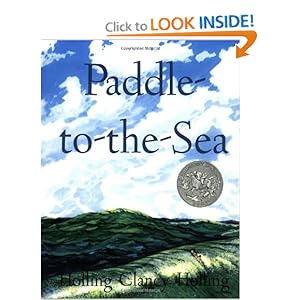
Today, we extended our studies of the native American people by reading the first five chapters of Paddle to the Sea, by H. C. Hollings. Hollings incorporates geography, history, science, and culture into wonderful living books. This one focuses on the Great Lakes regions from a turn of the century Indian boy's point of view.
Today's reading brought into mind some different interests. Since one chapter mentioned the tracks left in the snow by wildlife, we recalled the tracks we saw in the mud at our last creek visit. Then G remembered that we had made plaster casts of tracks several years ago. We examined a muskrat print, several deer tracks, and a blue heron footprint. Then the kids used the plaster casts to make their own tracks in wet sand. Fun!
The book also talked about deer shedding their antlers in the spring- so we examined a deer antler from the nature table.
The book also describes the geography of the Great Lakes, as descending bowls that allow their water to flow to the sea. So the kids constructed this in the sandbox, poured in water, and had a nifty model of the Great Lakes.
 |
| Creating the Great Lakes in the sandbox |
 |
| Having some unstructured time... |
 |
| How the book describes the descending lakes |
 |
| A blue heron footprint cast |
Creating the Great Lakes!